
 GIFT COUPON
STUDIES ON ANTI-CARIES PROPERTIES

In the 1980s, studies on Japanese elementary school students confirmed the anti-caries effect of SANGI nano<mHAP> toothpaste.
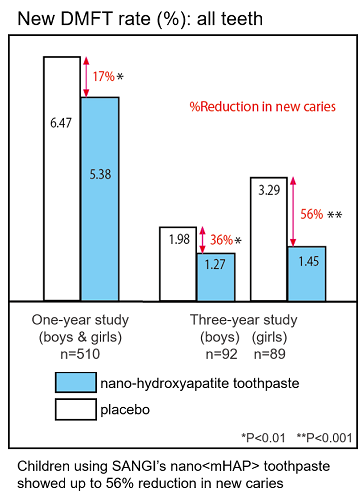
In a one-year study conducted by scientists from Tokyo Medical and Dental University (510 children)¹ and a three-year study conducted by scientists from the former Gifu University (181 children)², boys and girls brushed their teeth daily during lunch breaks under the supervision of teachers. They used either nano<mHAP> containing toothpaste or an identical paste without nano<mHAP>.
At the start of the studies, teeth free of caries were observed, as well as all new teeth that erupted during the study period. At the end of each year, the occurrence of new caries lesions was assessed using the DMFT index (decayed/missing/filled teeth).
The results showed that nano<mHAP> toothpaste significantly reduced the number of new caries cases in both existing and newly erupted teeth. In the three-year study, the reduction in caries reached an impressive 36–56%.
1. N.Shimura et al, Field Study on the Anticaries Effect of Toothpaste Containing Hydroxyapatite (First Report), J Dent Med 15(2):213-218, 1982 (Japanese language)
2. T.Kani et al, Effect of Apatite-Containing Dentifrices on Dental Caries in School Children, J Dent Hlth 39(1):104-109, 1989


